
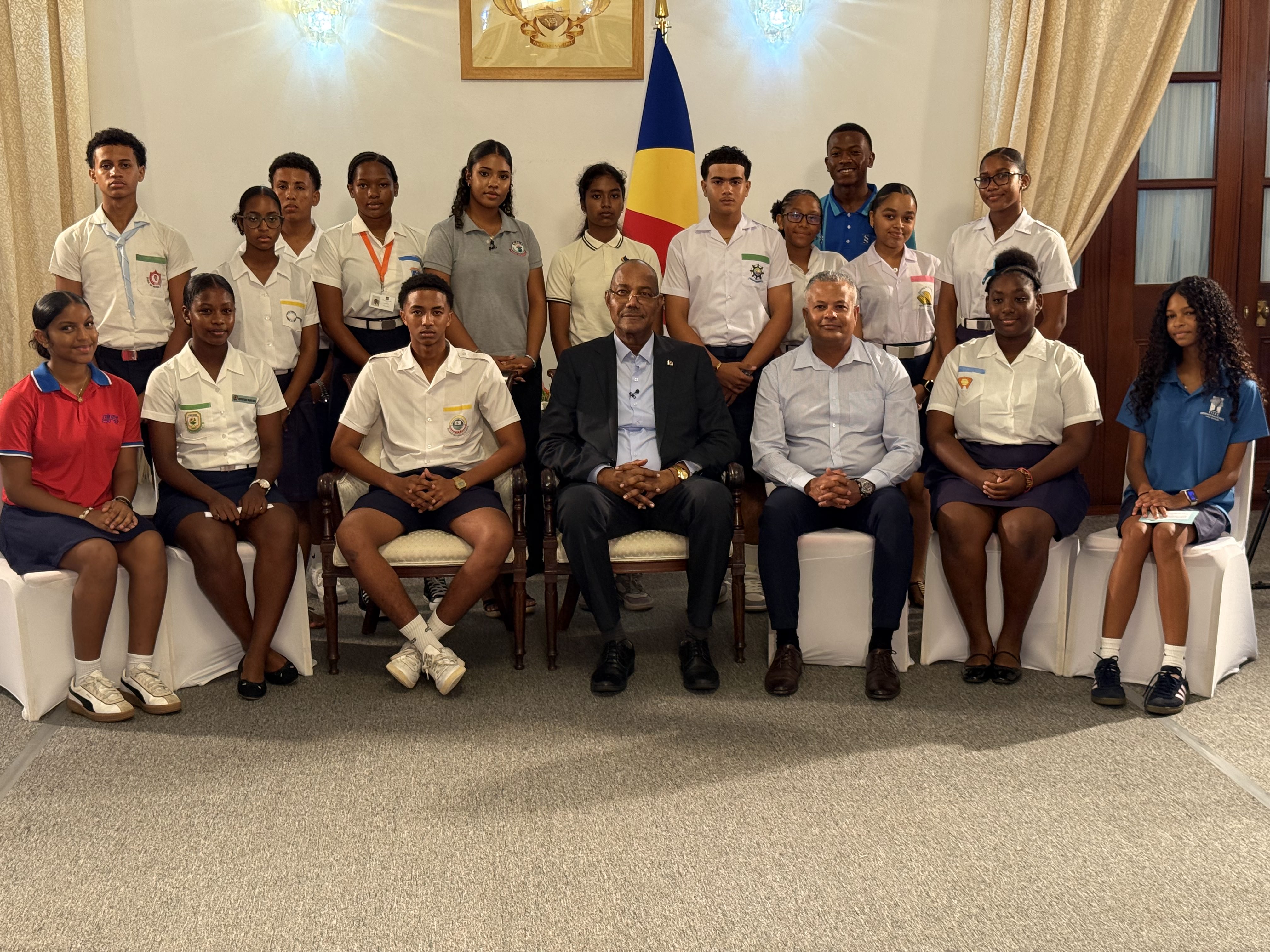
President Dr. Patrick Herminie has extended his heartfelt appreciation to the children who participated in the Universal Children’s Day Live Dialogue, organised in collaboration with the National Council for Children (NCC) on Friday 20th November 2026. He commended the thoughtfulness of their questions, which reflected their awareness on national issues, their desire to participate in shaping the country’s future, and the importance of providing them with honest answers.
From free education and safer schools to skills development, employment, affordable food and the environment, the children's questions went to the heart of the issues shaping their future. The President’s outlined ongoing government initiatives, policy priorities and proposed measures to address these concerns.
The dialogue was a reminder of how the Government is working for children and young people: listening to them, staying attentive to the issues they consider important, and turning their concerns into action.
Here is a recap of what was discussed.
Education: free, smart and inclusive
The President reaffirmed that the Government has no plan or intention to make parents pay for education, and that free education will continue as one of its obligations. He noted that SCR 1.2 billion has been injected into the budget, part of it for school resources. He also highlighted the importance of a stable home environment and parental support in ensuring equal educational opportunities, while encouraging students to take responsibility for their learning materials.
He outlined the Government's plans to advance smart education: computers in every school, technology for all students, and free internet access in all schools, with internet access also to be extended across Victoria. The secondary curriculum is being reviewed. The Ministry of Education has introduced a framework on AI in education, and ethical guidelines on students' use of AI are now being pursued.
On special educational needs, the President noted the Ministry's inclusive education division. He said teachers must be trained and the right infrastructure put in place, so that children with needs such as autism can become independent and responsible citizens. To address teacher shortages, a new scheme of service has been introduced, teachers will be trained in new technology, especially at primary level, and a teacher retention programme is needed. Expatriate teachers will fill gaps in the meantime.
Safe schools and children's wellbeing
President Herminie expressed deep concern about violence in schools, highlighting how the recording and circulation of incidents through mobile phones can compound the harm experienced by students.
He outlined measures to strengthen school safety and student wellbeing, including expanding the Ministry of Education’s anti-bullying programme launched in November, the planned opening of the Youth Hope School, and the provision of counselling and psychological support across schools.
All new schools will have stronger security to keep out intruders and drugs. While noting that "children will always be children", he said the school code of conduct must be reviewed, and that emotional intelligence should be instilled in children from a young age.
On drugs, the President said the most important measure is rehabilitation, supported by proper facilities and trained personnel. He pointed to the reintroduction of the Agency for the Prevention of Drug Abuse (APDA) and its prevention programme, an intensive search-and-destroy policy on supply, a new Drug Enforcement Unit, and new technology that can detect drug possession or recent contact with drugs.
The President acknowledged that mental health issues are significant in Seychelles and affect children too, which is part of the reason the Government established the Mental Health Agency. He emphasised the need to strengthen mental health support within schools, noting that he continues to pursue scholarship opportunities in psychology and psychotherapy through diplomatic engagements and overseas missions, with particular consideration for Seychelles’ needs
Skills, TVET and the future workforce
The President confirmed that funding and a site have been secured for a new, highly specialised TVET school, expected to be completed by 2027, as part of the Government's commitment to restore the dignity of vocational studies. Not every child is drawn to academic study, he said, and vocational education opens other opportunities. He welcomed the idea of scholarships in technical and vocational fields, which the Government will explore.
To tackle workforce shortages, a Human Resource Development Plan is being developed to identify skills gaps, to be followed by a programme matching solutions to each gap. A new Pivot School will train young people in basic trades such as carpentry and masonry, drawing on the Service Militaire Adapté model the President observed in Réunion. He also called on professionals educated at the State's expense to come back and serve the country, noting that some of the best doctors and dentists in Australia are Seychellois.
Economy, Diversification, and entrepreneurship
The President agreed that Seychelles can no longer rely on tourism alone, citing the impact of the wars in Ukraine and the Gulf on tourist arrivals and revenue. He named the blue economy, including aquaculture, and agri-tech and hydroponics as priorities for diversifying the economy. He credited the Government's measures with keeping shelves stocked and the country stable during the war in the Gulf, while stressing that diversification remains essential.
On youth entrepreneurship, he pointed to programmes such as Ignite and Step Up for Life, and to entrepreneurship being introduced as a subject in the school curriculum. He described public toilets as a business opportunity open to all. He also said athletes with potential who are performing well internationally continue to be supported through specific programmes.
Cost of living and nutrition
The President said 11 added items have been added to the list of essential commodities since he took office, and that the Government intends to keep their prices low. The Ministry of Health is to develop a nutrition policy to guide the list, so that nutritious food stays affordable. He said he does not foresee any food shortage this year.
Environment and sustainability
On coastal erosion, the President said its impact can be seen on many of the country's coasts. The Government will continue its coastal protection programme and keep seeking funding for such projects. On the Grand Police development in Takamaka, he said the Government inherited the matter and will conduct an Environmental Impact Assessment before any decision is taken. That decision will weigh the protection of the environment, the country's reputation and the legal implications. He stressed the need to balance conservation and development.
Youth voice and leadership
President Herminie said all youth-related policies must have input from the Youth Empowerment Committee. The Committee is developing a National Youth Policy to make sure young people have a voice in every aspect of national development. Asked what it takes to become President, he named conviction, values, integrity, hard work, discipline and humility, together with empathy for the most vulnerable and the drive to deliver for the majority of the people.
Closing the dialogue, the President said he hopes to leave behind a Seychelles that is transformed, developed, makes beneficial use of technology and is spiritually strong.