






ANTALYA, Türkiye, 9 November 2026 – The Association of Southeast Asian Nations (ASEAN), in partnership with the European Union (EU) and Germany, has once again established the ASEAN Pavilion at the 2026 United Nations Climate Change Conference (UNFCCC COP31). The Pavilion builds on ASEAN Leaders’ commitment to advancing collective climate action and strengthening regional cooperation, as articulated in the annual ASEAN Joint Statement on Climate Change (AJSCC) to the Conferences of the Parties to the United Nations Framework Convention on Climate Change (UNFCCC COPs).
Aligned with COP31’s guiding principles of dialogue, consensus and action, the ASEAN Pavilion seeks to accelerate and advance regional climate action in line with ASEAN’s shared priorities. It showcases regional initiatives, fosters partnerships, and highlights ASEAN’s contributions to the implementation of the Paris Agreement and the COP31 Action Agenda through coordinated national and regional efforts.
The ASEAN Pavilion also reflects the longstanding partnership between ASEAN, the European Union, and Germany in advancing regional climate cooperation. A key highlight of the Pavilion’s programme is ASEAN–EU Day on 10 November 2026, underscoring the longstanding ASEAN–EU Strategic Partnership and their shared commitment to climate action and sustainable development. Since becoming Dialogue Relations in 1977, ASEAN and the EU have expanded their cooperation across various sectors, including efforts to strengthen regional resilience.
The opening session brought together representatives from ASEAN Member States (AMS), the EU, and other ASEAN partners to mark the commencement of ASEAN’s engagement through the ASEAN Pavilion at COP31. In his opening remarks, Dr Kao Kim Hourn, Secretary-General of ASEAN, underscored the ASEAN Pavilion’s significance in demonstrating the region’s shared commitment to addressing climate change and highlighting ASEAN’s leadership, achievements, and collaborative efforts in advancing climate action on the international stage.
“This Pavilion will serve as an inclusive space for dialogue and collaboration throughout COP31. Over the coming days, we will showcase ASEAN’s leadership in accelerating climate action: from energy transition, enhancing climate finance, mobilising private sector participation, scaling nature-based solutions, and advancing just transition approaches. We will also amplify the voices of youth, women, communities, and all stakeholders driving real change from the ground up,” H.E. Dr Kao Kim Hourn, Secretary-General of ASEAN
“Guided by our Philippine Chairship theme, “Navigating Our Future, Together,” we affirm that because climate impacts transcend national borders, our solutions must be rooted in deep regional cooperation, inclusivity, and shared responsibility. As the 2026 ASEAN Chair, the Philippines is committed to championing a unified regional climate agenda anchored in the ASEAN Community Vision 2045 and our 2026–2030 strategic plans,” H.E. Juan Miguel T. Cuna, Secretary of Department of Environment and Natural Resources, the Philippines.
“ASEAN has made steady progress in translating its climate commitments into action at the political, national and regional levels. But we intend to do more. As ASEAN moves from setting targets to delivering on them, we will need stronger partnerships and significantly greater investment to implement our NDCs, accelerate the development of the ASEAN Power Grid, and strengthen adaptation. As Singapore prepares to assume the ASEAN Chairmanship next year, we will build on the work of the Philippines by working with fellow ASEAN Member States and our partners to strengthen the region’s climate resilience. This includes building capabilities, better understanding our climate risks, and mobilising partnerships and financing to translate adaptation priorities into practical action,” Mr. Joseph Teo, Singapore’s Chief Negotiator for Climate Change, the Ministry of Sustainability and the Environment (MSE) of Singapore.
“ASEAN’s strength lies in our spirit of solidarity, or what we called “Gotong Royong” in Indonesia, which means working together, hand in hand, and shoulder to shoulder. Let us continue to strengthen this spirit as we address climate change in the ASEAN region, protect our people and ecosystems, and secure a sustainable and resilient future for generations to come,” Ir. Ary Sudijanto, Deputy Minister for Climate Change and Carbon Economic Governance, Ministry of Environment of Indonesia.
“The European Union is proud to support the ASEAN Pavilion alongside Germany, reflecting our shared commitment to multilateralism and ambitious climate action. As we approach the 50th anniversary of EU–ASEAN Dialogue Relations in 2027, this Pavilion turns shared ambition into practical cooperation for communities across the region. Together, we are strengthening climate resilience through adaptation and nature-based solutions, advancing carbon pricing and carbon markets, and accelerating a just, secure and affordable clean-energy transition through renewables, stronger grids and regional energy cooperation,” H.E. Marina Rafti, Ambassador of the European Union to ASEAN
Through its diverse programme of events throughout COP31 from 9 to 20 November 2026, the ASEAN Pavilion welcomes inclusive participation and collective efforts of stakeholders from across sectors, including policymakers, dialogue and development partners, academia, civil society and the private sector, to engage in open dialogue and explores opportunities to advance climate action in ASEAN, while contributing to the priorities of COP31 Presidency.
The ASEAN Pavilion at UNFCCC COP31 is supported through the ASEAN-EU-German Climate Action Programme (CAP), funded by the European Union (EU) and Germany, and implemented by the Deutsche Gesellschaft für Internationale Zusammenarbeit (GIZ) GmbH in partnership with the ASEAN Working Group on Climate Change (AWGCC) and the ASEAN Secretariat.
The Association of Southeast Asian Nations (ASEAN) was established on August 8, 1967, and comprises eleven Member States: Brunei Darussalam, Cambodia, Indonesia, Lao PDR, Malaysia, Myanmar, the Philippines, Singapore, Thailand, Timor-Leste and Viet Nam. On 31 December 2015, the ASEAN Community was formally established. The ASEAN Secretariat is based in Jakarta, Indonesia.


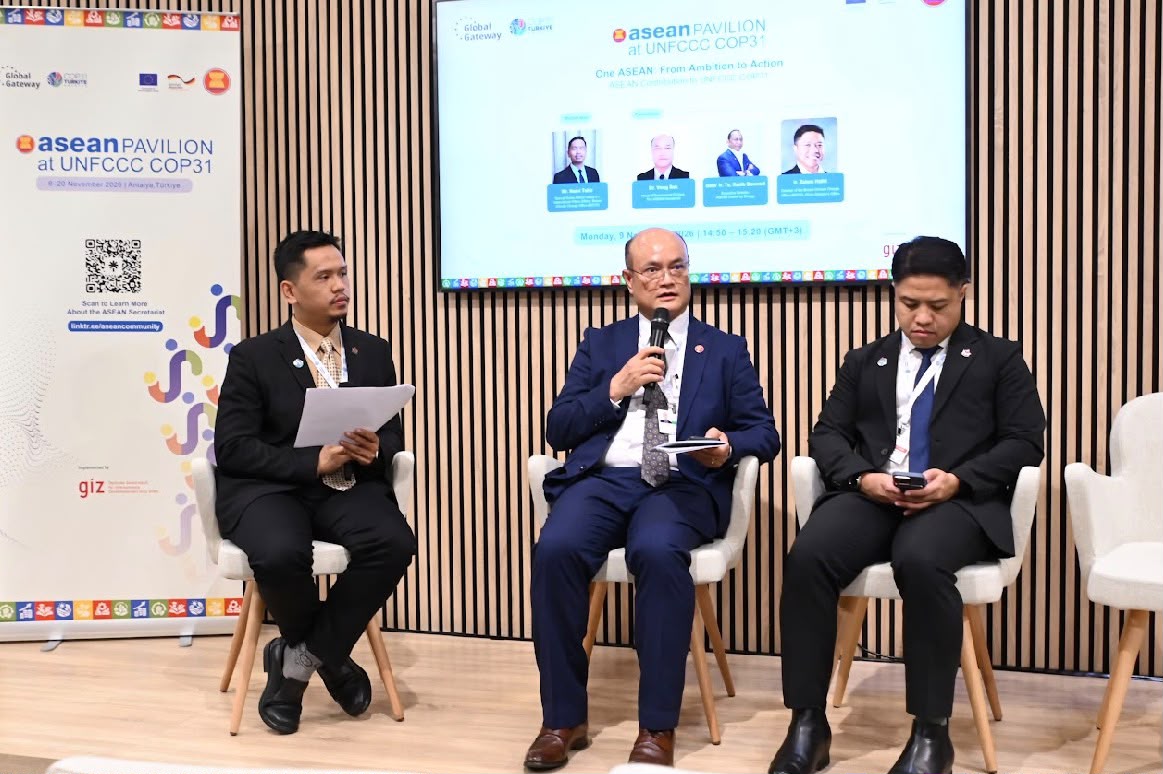


Photo credit: ASEAN Secretariat
